The Rise of Microlearning and Why Short Lessons Work
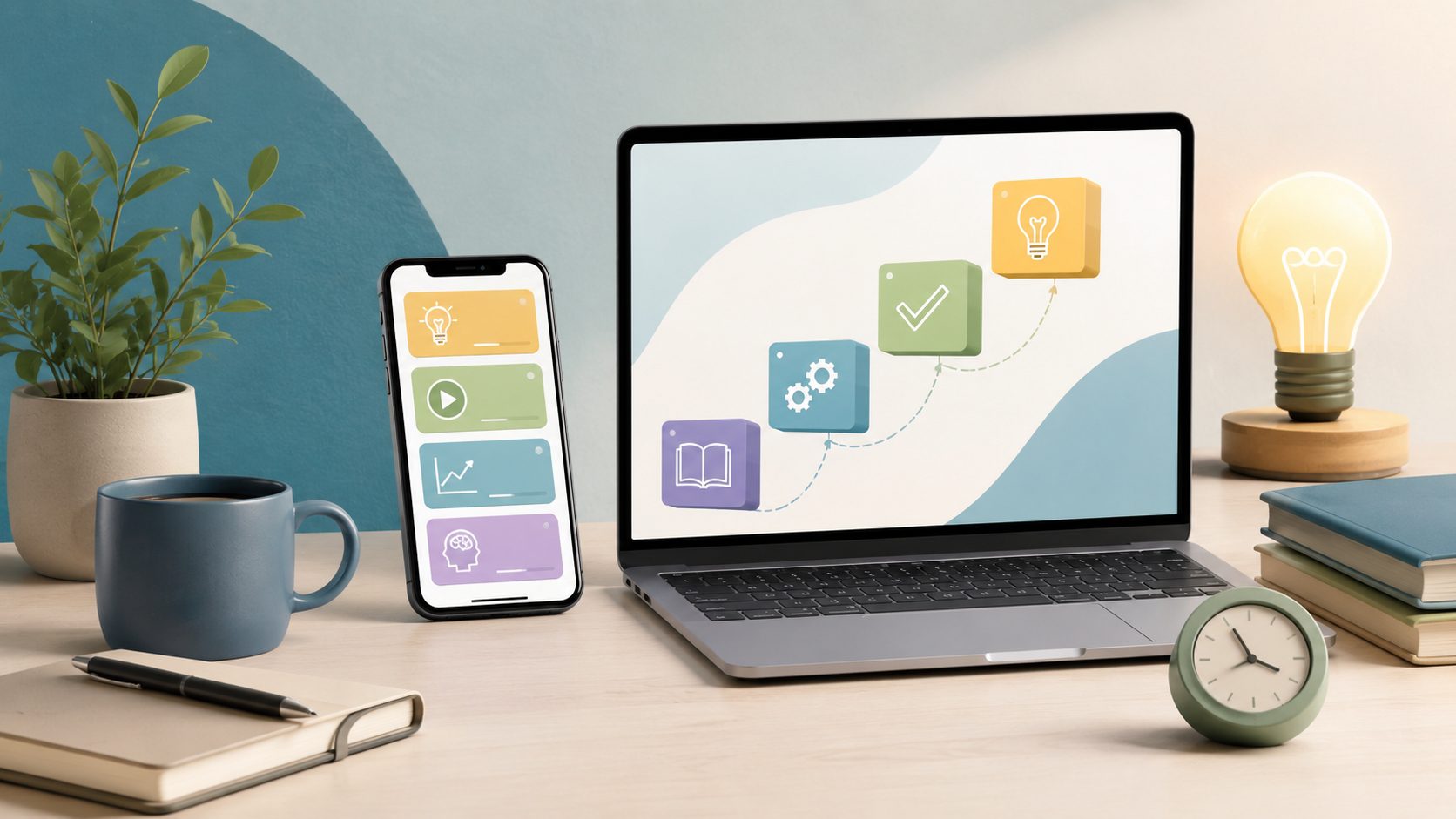
Think about the last time you learned something useful online. Maybe it was a three-minute video showing you how to fix a spreadsheet formula, a short language lesson during a commute, or a quick tutorial for a new app. You probably did not sit down intending to “study.” You simply needed a piece of information and wanted it quickly.
That is the basic idea behind microlearning: breaking learning into small, focused lessons that can usually be completed in a few minutes. It has become especially appealing as adults try to fit professional development, hobbies, and everyday problem-solving into busy schedules.
The appeal is not just convenience. When short lessons are designed well, they can match several principles that researchers know support memory and learning. Microlearning is not simply a long course cut into smaller pieces; each lesson needs a clear purpose.
Why Microlearning Fits Modern Life
Traditional learning often assumes that people can set aside a large, uninterrupted block of time. For many adults, work, family responsibilities, errands, messages, and digital interruptions can make a 60-minute lesson feel much harder to start than a five-minute one.
Microlearning lowers that barrier. Someone can review a few phrases in a new language while waiting for an appointment, learn one Excel shortcut between tasks, or complete a brief safety refresher before starting a shift.
That flexibility is one reason microlearning has found a home in workplace training, education, and self-directed learning. A review of microlearning research published through the National Library of Medicine notes that small units can give learners flexible access to information and skills across different settings.
The format also works well with phones and other devices people already use throughout the day. Instead of treating learning as a separate event, microlearning can fit naturally between other activities.
Shorter Lessons Can Reduce Mental Overload
There is a practical limit to how much new information we can actively work with at once. When a lesson introduces too many ideas too quickly, it becomes harder to decide what matters, connect new information to what we already know, and remember it later.
Short lessons can help by narrowing the focus. A well-designed session might teach one concept, demonstrate one process, or ask the learner to practice one skill. That gives the learner fewer competing pieces of information to manage at the same time.
This does not mean complex subjects should be reduced to simplistic explanations. A topic such as personal finance, coding, or project management may still require substantial learning. Microlearning simply divides the larger journey into smaller steps.
For example, a budgeting course might separate fixed expenses, variable expenses, emergency funds, debt repayment, and savings goals into individual lessons. Each piece remains connected to the bigger subject, but learners do not have to process everything in one sitting.
Spacing and Retrieval Make Small Lessons More Powerful
Short lessons become especially useful when they are revisited over time. Research on the “spacing effect” has repeatedly found that people tend to remember information better when study sessions are distributed rather than packed into one long session.
A large study summarized by PubMed on the timing of spaced learning found that reviewing information after a delay can support longer-term retention, with the best spacing depending partly on how long the material needs to be remembered.
Microlearning fits naturally with this idea. Instead of taking a two-hour course once and never opening it again, a learner might spend five or ten minutes on related material several times during the month.
Another useful principle is retrieval practice: actively trying to remember something rather than simply rereading it. The American Psychological Association’s guidance on research-backed study strategies highlights repeated retrieval as an effective way to strengthen memory.
That is why a short quiz, flashcard, scenario, or “explain this in your own words” prompt can improve a micro-lesson. The learner is not just consuming information; they are practicing pulling it back out of memory.
When Microlearning Works—and When It Does Not
Microlearning is useful, but it is not the right format for everything. Some skills require extended concentration, sustained practice, discussion, or the chance to work through a complicated problem from beginning to end.
You would not want a surgeon, electrician, or pilot to rely only on a collection of five-minute lessons. Short modules may support training in those fields, but they cannot replace supervised practice, deeper instruction, or real-world experience.
The same applies to everyday skills. A four-minute guitar video can teach a chord, but becoming a good guitarist still requires practice. A short writing lesson can explain how to structure an argument, but producing a strong essay takes time to plan, draft, and revise.
The best use of microlearning is often as one layer of a larger learning process. It can introduce a concept, refresh knowledge, reinforce something learned earlier, or provide a quick answer at the moment of need.
For learners, the practical takeaway is simple: choose short lessons with a specific goal, return to important ideas more than once, and occasionally test yourself instead of only reviewing.
The rise of microlearning reflects a simple reality: people still want to learn, but they do not always have long stretches of uninterrupted time. Short lessons make learning easier to start, revisit, and fit into everyday life.
Their real strength, however, comes from good design. When microlearning combines a clear focus with spacing, practice, and opportunities to recall what was learned, small lessons can become part of serious, lasting learning. Sometimes the most effective way to make progress is not to study more at once, but to learn one useful thing and come back for the next piece later.